CARO Applicability for FY 2025 26: Rules, Exemptions and New Small Company Limits
The applicability of the Companies (Auditor’s Report) Order, 2020 (CARO 2020) for FY 2025 26 requires particular attention due to the change in the definition of a Small Company effective from 1 December 2025.
The Ministry of Corporate Affairs increased the prescribed Small Company limits from ₹4 crore to ₹10 crore for paid up share capital and from ₹40 crore to ₹100 crore for turnover.
Since Small Companies are excluded from CARO 2020, the amendment can affect the CARO applicability assessment for FY 2025 26.
What is CARO 2020?
CARO 2020 prescribes additional matters on which the statutory auditor is required to report. It applies to financial years commencing on or after 1 April 2021, subject to specified exclusions.
The reporting requirements cover areas including property, plant and equipment, inventory, loans and advances, statutory dues, borrowings, fraud, related party transactions, internal audit, cash losses, going concern matters and consolidated financial statements.
Before applying the individual reporting clauses, the auditor must first determine whether CARO 2020 applies to the company.
Companies Excluded from CARO 2020
CARO 2020 does not apply to:
- Banking companies
- Insurance companies
- Companies licensed to operate under Section 8 of the Companies Act, 2013
- One Person Companies
- Small Companies
- Certain private companies satisfying the conditions specified in CARO 2020
The last two exclusions require a detailed assessment.
Small Company Limits for FY 2025 26
Section 2(85) of the Companies Act, 2013 defines a Small Company.
With effect from 1 December 2025, the prescribed limits are:
Particulars | Limit |
|---|---|
Paid up share capital | ₹10 crore |
Turnover | ₹100 crore |
Both conditions must be satisfied.
The turnover condition refers to the turnover as per the profit and loss account for the immediately preceding financial year.
Therefore, for FY 2025 26, the relevant turnover for this test is generally the turnover of FY 2024 25.
A company satisfying the financial limits must also fall within the definition of a Small Company under Section 2(85). Certain companies are excluded from the definition, including holding companies, subsidiary companies and Section 8 companies.
Example
A private company has paid up share capital of ₹8 crore and turnover of ₹75 crore for FY 2024 25. If it is not otherwise excluded from the definition of a Small Company, it qualifies as a Small Company.
As Small Companies are excluded from CARO 2020, CARO would not apply.
Private Company Exemption Under CARO 2020
A private company that does not qualify as a Small Company may still be exempt from CARO 2020 if it satisfies all the conditions prescribed in the Order.
The conditions are:
Condition | Requirement |
|---|---|
Relationship with public company | Not a subsidiary or holding company of a public company |
Paid up capital plus reserves and surplus | Not more than ₹1 crore |
Borrowings from banks or financial institutions | Not more than ₹1 crore at any point during the financial year |
Total revenue | Not more than ₹10 crore |
All conditions must be satisfied.
The borrowing condition is particularly important. The auditor should consider borrowings during the entire financial year because the limit applies at any point of time during the year. A year end borrowing below ₹1 crore does not by itself establish compliance with this condition.
The ₹1 crore limit for capital plus reserves and surplus should also not be confused with the ₹10 crore paid up capital limit applicable to the Small Company definition.
CARO Applicability Decision Process
For a private company, the assessment can be performed in the following order:
Step 1: Determine whether the company falls within one of the general exclusions under CARO 2020.
Step 2: Determine whether the company qualifies as a Small Company under Section 2(85).
For FY 2025 26, check:
Paid up share capital ≤ ₹10 crore
and
Immediately preceding financial year turnover ≤ ₹100 crore
Also consider the exclusions from the Small Company definition.
Step 3: If the company is not a Small Company, check whether it satisfies all four conditions for the specific private company exemption under CARO 2020.
Step 4: If no exclusion or exemption applies, CARO 2020 is applicable.
CARO Applicability Examples
Private company with ₹8 crore capital and ₹80 crore turnover
If the company satisfies all other requirements of Section 2(85), it qualifies as a Small Company and CARO 2020 does not apply.
Private company with ₹12 crore capital and ₹80 crore turnover
The company does not qualify as a Small Company because its paid up share capital exceeds ₹10 crore.
The separate private company exemption must then be examined. If paid up capital plus reserves exceeds ₹1 crore, that exemption is not available on that basis.
Private company whose borrowing exceeded ₹1 crore
Even if the borrowing is below ₹1 crore at year end, exceeding ₹1 crore at any point during the financial year means the borrowing condition for the private company exemption is not satisfied.
CARO 2020 Reporting Requirements
Where CARO 2020 applies, the auditor reports on the matters specified in the Order.
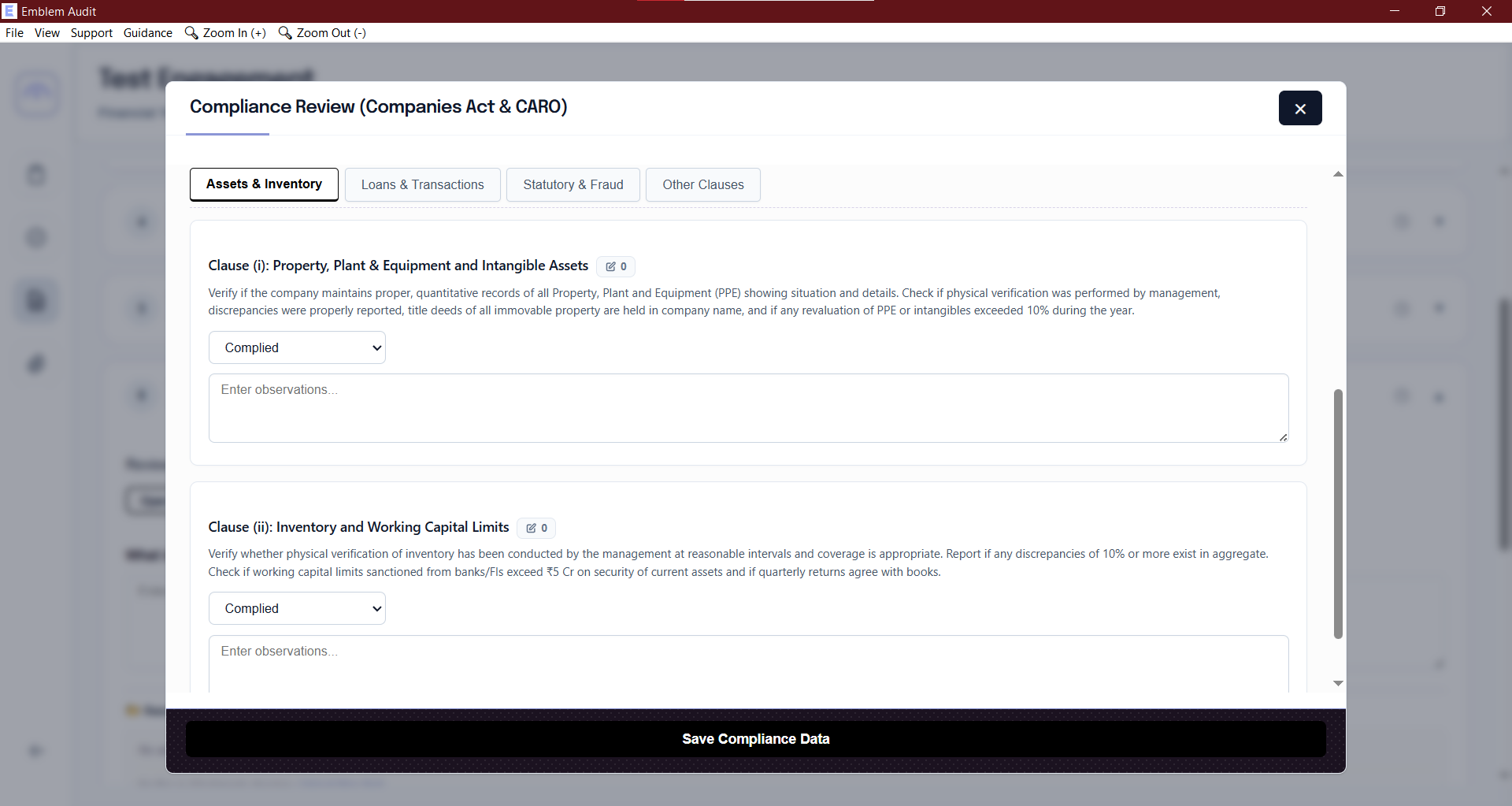
The principal areas include:
Area | Key reporting matters |
|---|---|
Property, plant and equipment | Records, physical verification, title deeds and revaluation |
Inventory | Physical verification and discrepancies |
Working capital | Statements submitted to banks or financial institutions |
Loans and advances | Terms, repayment and overdue amounts |
Sections 185 and 186 | Compliance with applicable provisions |
Deposits | Compliance with applicable provisions |
Cost records | Maintenance of prescribed records |
Statutory dues | Regularity and disputed dues |
Borrowings | Defaults, wilful defaulter status and utilisation |
Fraud | Fraud identified or reported and whistle blower complaints |
Related parties | Compliance and disclosures |
Internal audit | Internal audit system and consideration of reports |
Cash losses | Cash losses during the current and preceding year |
Auditor resignation | Consideration of issues raised by the outgoing auditor |
Liabilities | Ability to meet liabilities falling due within one year |
CSR | Transfer of unspent amounts where applicable |
Consolidated financial statements | Qualifications or adverse remarks in component CARO reports |
CARO Applicability Checklist for FY 2025 26
Before concluding on CARO applicability, the auditor should document:
Company status
- Whether the company falls within the scope of CARO 2020
- Whether it is a banking or insurance company
- Whether it is a Section 8 company
- Whether it is an OPC
- Whether it is a holding or subsidiary company
- Whether it is governed by a special Act
Small Company test
- Paid up share capital
- Turnover of the immediately preceding financial year
- Applicability of the exclusions under Section 2(85)
Private company exemption
- Paid up capital plus reserves and surplus
- Maximum bank or financial institution borrowings during the year
- Total revenue
- Relationship with public companies
The audit working papers should clearly state the specific exemption or provision on which the conclusion is based.
Frequently Asked Questions
Is CARO 2020 applicable for FY 2025 26?
Yes. CARO 2020 continues to apply to financial years commencing on or after 1 April 2021, subject to the exclusions and exemptions specified in the Order.
What is the new Small Company limit for FY 2025 26?
From 1 December 2025, the prescribed limits are ₹10 crore for paid up share capital and ₹100 crore for turnover, subject to the other requirements of Section 2(85).
Is CARO applicable to a private limited company?
Not necessarily. A private company may be outside CARO if it qualifies as a Small Company or satisfies the specific private company exemption under CARO 2020.
Is CARO applicable if turnover is below ₹100 crore?
Not necessarily. The company must also satisfy the ₹10 crore paid up share capital condition and the other requirements for being a Small Company. If it does not qualify as a Small Company, another applicable CARO exemption must be examined.
Is ₹5 crore the CARO applicability limit?
No. The ₹5 crore threshold in CARO 2020 relates to a specific reporting requirement and is not the general threshold for determining CARO applicability.
Conclusion
The revised Small Company limits make the CARO applicability assessment for FY 2025 26 particularly important.
For a company to be outside CARO because it is a Small Company, the auditor should verify the revised ₹10 crore paid up share capital and ₹100 crore immediately preceding year turnover limits, along with the other requirements of Section 2(85).
If the company is not a Small Company, a private company should be tested separately against the ₹1 crore capital and reserves, ₹1 crore borrowing and ₹10 crore revenue conditions prescribed under CARO 2020.
Accordingly, the CARO conclusion should be based on a documented assessment of the applicable exclusions and exemptions rather than on turnover alone.
Need a CARO Checklist?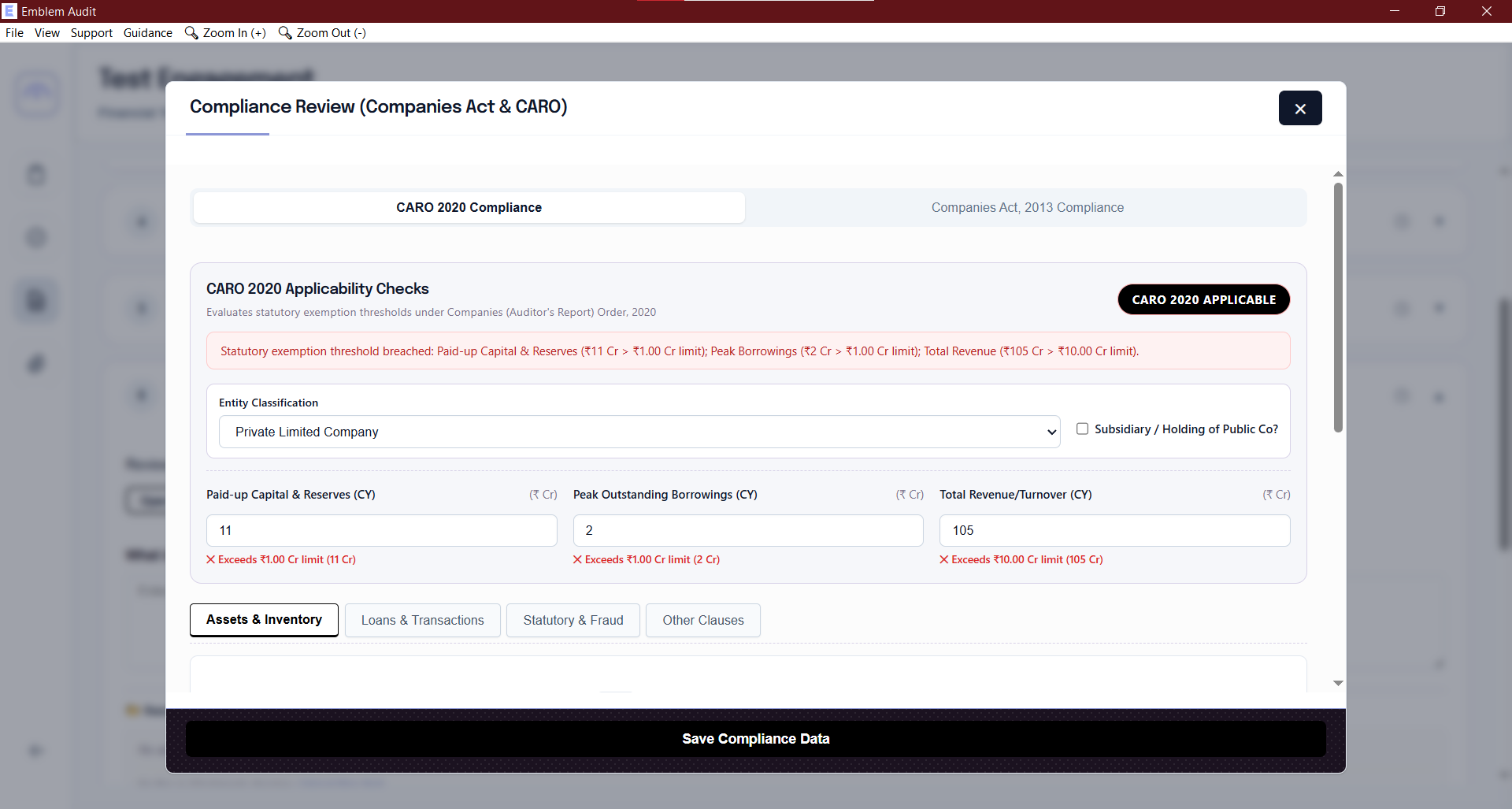
Don’t start from scratch. Get the EmblemAudit Offline Desktop App and access ready to use audit workpapers and documentation software at your finger tips.
Download the EmblemAudit Offline Desktop App and make your audit work faster and more structured.
👉 Download the EmblemAudit App
Available for Windows.